
Why Humans Queue Like Ants — The Behavioral Economics of the Audemars Piguet x Swatch Drop

THE ALGORITHMIC SUGAR TRAIL
Why Humans Queue Like Ants — The Behavioral Economics of the Audemars Piguet x Swatch Drop
The queue is not irrational. It is a pheromone trail. And someone designed it that way.
I was scrolling Instagram on a random Saturday morning when I saw the queue.
Hundreds of people. Wrapped around a block. Some had been there since the night before, sleeping on pavements outside a watch boutique. The object they were waiting for was a watch — a collaboration between Audemars Piguet, one of the most prestigious Swiss watchmakers in existence, and Swatch, the company that sells plastic watches at airports. The retail price: approximately $325. The wait time: eight to twelve hours in some cities.
My first thought was simple. Why are humans behaving like ants over sugar?
My second thought — which arrived about thirty seconds later as I kept scrolling and saw the same queue replicated in London, Singapore, Dubai, and Mumbai — was more interesting. This is not random. This was designed. Someone built this queue deliberately, with precision, using tools that are not intuitive but are completely understood by the people deploying them.
I spent the week after that Instagram scroll trying to understand the mechanism. What I found is that the Audemars Piguet x Swatch collaboration is not really about a watch. It is about one of the most sophisticated applications of behavioral economics and synthetic scarcity architecture in modern consumer markets. And the queue is not a side effect of the launch. The queue is the product.
I. What the Watch Actually Is
The Audemars Piguet Royal Oak is one of the most iconic watch designs in history. Designed by Gérald Genta in 1972, it became the defining object of a certain kind of aspiration — the watch that serious collectors wore when they wanted to signal that they understood watchmaking at a level beyond obvious luxury.
Today, a genuine Audemars Piguet Royal Oak costs between $30,000 and $300,000. The waitlist for certain references runs to years. The watch is, in the most literal financial sense, an alternative asset — something that holds value, appreciates over decades, and represents a store of wealth that transcends fashion cycles.
The Swatch Group produces watches at the opposite end of the spectrum. Functional, affordable, fashionable in cycles, designed for accessibility rather than exclusivity.
The collaboration between these two companies produces something that is neither. It is not a genuine Audemars Piguet. It is not a standard Swatch. It is a proxy. A $325 object that allows someone to participate in the cultural conversation around a $30,000 object without the financial barrier to entry.
That proxy is the mechanism. Everything that follows is a consequence of it.
“The watch is not the product. The queue is the product. The $325 object is simply the mechanism that produces the queue — which is what both companies actually want.”
II. The Ant Science
Ants do not have a central command. No ant knows the full map of the colony’s territory. No ant is given instructions about where to find food. And yet ant colonies solve complex optimization problems with extraordinary efficiency — finding the shortest path between the colony and a food source, allocating workers to tasks in real time, responding to disruptions faster than any centrally planned system could.
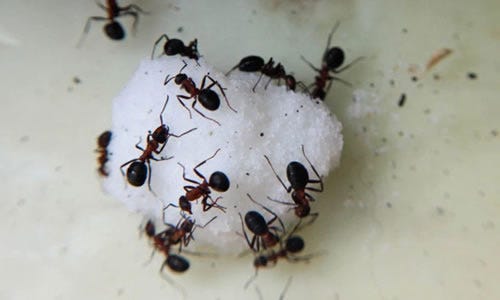
The mechanism is stigmergy — indirect coordination through environmental signals. When an ant finds food, it deposits pheromones on the path back to the colony. Other ants detect the trail and follow it. As more ants follow, more pheromones are deposited, making the trail stronger and attracting more ants. The path with the most traffic becomes the dominant path — not because any ant decided it was best, but because the signal reinforced itself.
Human consumer behaviour under scarcity conditions follows an almost identical pattern. One person queues outside a store. Others see the queue and process the same signal that ant pheromones provide — something valuable is here. They join. The queue gets longer. The longer queue signals more value to the next person who passes. By morning the queue is around the block and the signal is visible from Instagram to news websites to word of mouth chains that span continents.
Nobody coordinated this. The queue is self-organising stigmergy — the human pheromone trail.
“The queue is self-organising stigmergy. One person stands outside a store. Others see a signal. They join. The signal gets stronger. By morning the queue is around the block. No coordination required. The system does it automatically.”
III. The Metrics of Manufactured Scarcity
The behavioral pattern of high-low luxury collaborations follows a precise and measurable lifecycle.
Hype half-life window — 14 to 21 days. That is how long the cultural conversation stays alive before interest decays below launch threshold.
Average retail proxy price — $325. Accessible enough to create mass participation. Expensive enough to signal aspiration.
Initial arbitrage premium — +214%. Within 48 hours of launch, secondary market prices were more than triple retail. Not because the watch became more valuable. Because the queue created a signal of scarcity that drove demand beyond available supply — exactly as designed.
Secondary market saturation — week two to three. When reseller margins collapse as supply meets demand.
Social narrative half-life — 28 days. After which the product shifts from social asset to utility good.
The +214% initial premium is the most revealing number. By week four, the watch is a watch. The person who paid $700 on the secondary market in week one now owns a $325 object. The person who queued for eight hours and paid retail owns the same object. The only people who extracted genuine financial value are the brands — and the arbitrageurs who moved fast enough.
IV. The Synthetic Scarcity Architecture
The queue did not happen by accident. It was engineered with precision by two companies that understand consumer psychology at a level most people never think about.
Genuine scarcity — the kind that makes a real Audemars Piguet valuable — is produced by fixed constraints. Craft hours. Skilled watchmakers. Precious materials. The supply is limited because producing them requires resources that genuinely cannot be scaled.
Synthetic scarcity is different. It is a scheduling decision. Audemars Piguet and Swatch Group could produce more units. The Swatch Group’s manufacturing capacity is enormous. The limitation on the collaboration is not physical. It is strategic. The brands chose to release limited quantities because scarcity is more valuable than availability.
The regional boutique exclusivity — releases limited to specific stores in specific cities — adds a geographic dimension. The queue in Mumbai cannot purchase what is only available in London. The signal travels globally. The supply remains local. The gap between global desire and local supply is precisely where the cultural conversation lives.
This is not a flaw in the distribution strategy. It is the distribution strategy. The brands are not failing to meet demand. They are engineering the gap between demand and supply with mathematical precision because that gap produces the queue, and the queue produces the media coverage, and the media coverage produces the desire in the next cycle.
V. The Macroeconomic Context
The AP x Swatch collaboration launched into a specific economic moment that makes its mechanism more powerful than it would have been ten years ago.
In an inflationary environment where premium hard assets are structurally inaccessible to most consumers — where a genuine Audemars Piguet requires $30,000 minimum and a waitlist of years — the $325 proxy captures something real. It is not just about the watch. It is about the desire to participate in a conversation, to own a piece of a cultural narrative, to access an identity signal that was previously reserved for people with significantly more capital.
The collaboration is, in the most generous reading, a form of luxury democratization. In the less generous reading, it is a sophisticated extraction of consumer desire — taking the emotional energy that genuine luxury scarcity produces and monetising it at a price point accessible to a much larger market, while providing none of the financial value that genuine luxury delivers.
Both readings are correct. The brands benefit either way.
VI. The Honest Question — Is the Queue Irrational?
I want to answer this honestly because the easy answer is wrong.
The easy answer is that the queue is irrational. That people lining up for eight hours to pay $325 for a watch that will be worth less than $325 in social currency within a month are making a mistake. That they are ants following a pheromone trail that leads to sugar that will be gone before they get there.
But the honest answer is more complicated.
The people in the queue are not making a financial investment. They are making a social investment — purchasing access to a moment, a conversation, an identity signal that has real value in their social network for the duration of the hype cycle. If that value is worth eight hours of their time and $325, then the transaction is rational on their terms.
The irrationality, if it exists, is not in the individual decision. It is in the aggregate — the self-reinforcing stigmergy system that drives thousands of individual rational decisions into a collective behaviour that primarily benefits the brands that designed the system.
The ants are not stupid. The sugar trail was designed by something that understood ants.
The humans in the queue are not stupid. The queue was designed by people who understood humans.
The difference between the ants and the humans is that the humans can know this — can understand the mechanism, recognise the engineering, see the synthetic scarcity architecture for what it is — and then make a fully informed decision about whether they still want to stand in the queue.
Some of them will. Because the watch is genuinely beautiful. Because the moment of getting it is genuinely exciting. Because participating in a cultural event with thousands of other people, even a manufactured one, produces something real.
That is not irrational. That is human.
The question worth asking is not whether the queue is stupid. It is whether the people in it know what they are actually buying.
The algorithmic sugar trail is real. The sugar is real. It just dissolves faster than most people realise when they join the queue.
“The ants are not stupid. The sugar trail was designed by something that understood ants. The humans in the queue are not stupid. The queue was designed by people who understood humans. The difference is that humans can know this — and choose anyway.”
Selva Ganesh K | AI Research Analyst & Writer | Tamil Nadu, India | 2026
mysticquill.blogspot.com